
Why career decisions are won or lost before the options are on the table.
Salary. Growth. Impact. Family. Health. Faith. Most of us would agree that these are some of the key metrics that help us determine the "best" career path to take.
However, the "best", or "better", option is never the same for each one of us. Two people may face the same job choices while trying to achieve very different things, which means that the "better" option differs for each of them. So how is "better" supposed to get decided?
The Question We Ask Too Late
The correct question to ask is not which job is better, but what "better" means. That requires deciding what the career choice is supposed to achieve: the objectives it should serve.
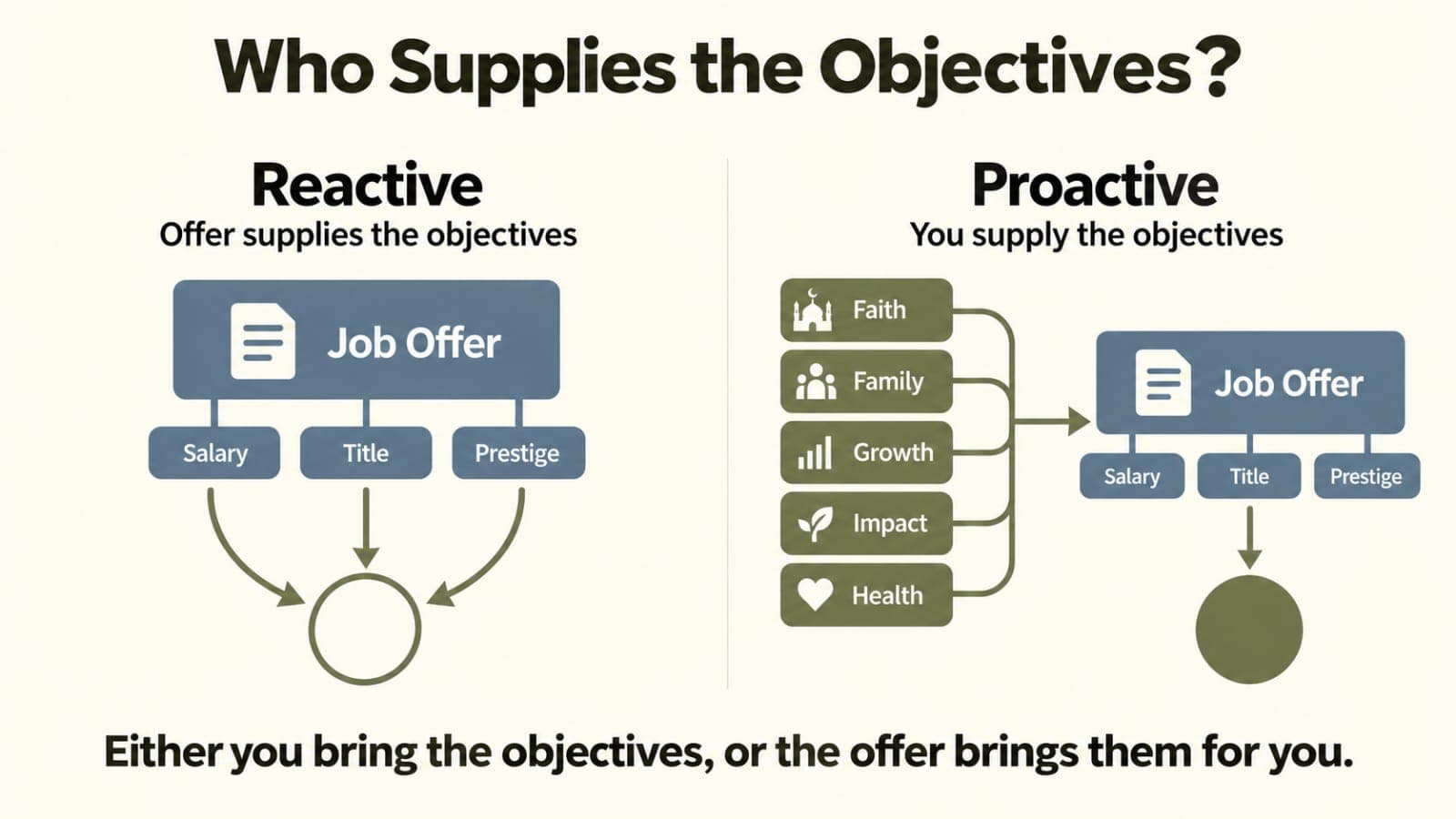
The problem is that people often define these objectives only when an offer is already in front of them. That is precisely when judgment is most vulnerable to familiar decision traps: with less time and more emotion, the most salient features of an offer — its salary, prestige, or immediate appeal — can begin to shape the decision before the person has decided what should matter. Dr Umar Taj, a behavioral decision scientist at London School of Economics, describes this as reactive decision-making.
The distinction between reactive and proactive behaviour helps explain the problem. Reactive people allow their feelings, circumstances, environment, or other people's behaviour to shape how they respond. Proactive people, by contrast, recognize that what happens to them does not automatically determine what they do next. They can choose to act according to their values rather than the pressures of the moment.
In career decisions, reactivity occurs when the situation begins to define the objectives by which the available choices are judged. An offer arrives with a high salary, a prestigious name, or an attractive title, and these readily available measures of success can stand in for objectives the person has never consciously defined.
Proactive decision-making reverses this: define the objectives before the offer supplies them, then judge each option by how well it serves them.
What Comes to Mind First Is Not What Matters Most
The difficulty is that defining those objectives is not always straightforward. The objectives that come to mind first are not necessarily the ones that matter most.
In one study, Executive MBA students initially generated about six objectives for choosing a job placement. After being shown a broader list of possible objectives and given time to reconsider, a third realised that they had not initially identified what they later ranked as their top three most important objectives. Four in five found at least one objective in their eventual top three that they had not thought of on their own.
Proactive decision-making therefore requires more than defining objectives early; it requires deliberately looking for objectives that might otherwise be overlooked. Prompts, broader lists, and conversations with other people can help by bringing neglected considerations into view.
This matters particularly for faith and ethics, which may genuinely matter to someone without being made salient by a professional environment. Once these objectives are clear, they provide the standards by which the available options can be judged — in other words, they determine what "better" means.
Faith Is Not a Personal Footnote to a Professional Decision
For a Muslim, that definition of "better" may include religious learning, community, and the ability to live according to one's faith. It may be tempting to treat these as personal considerations to be weighed only after the "professional" factors have been assessed.
But if they genuinely matter to the person, they are objectives in their own right and should be weighed alongside compensation, growth, impact, and other professional concerns.
Putting It on One Page
For those objectives to guide the decision consistently, they need to be made explicit. A Decision Matrix brings them together in one place — compensation, high-impact work, mentorship, the likelihood of developing excellence, and access to religious learning and community — and forces the decision-maker to consider their relative importance and the trade-offs between them.
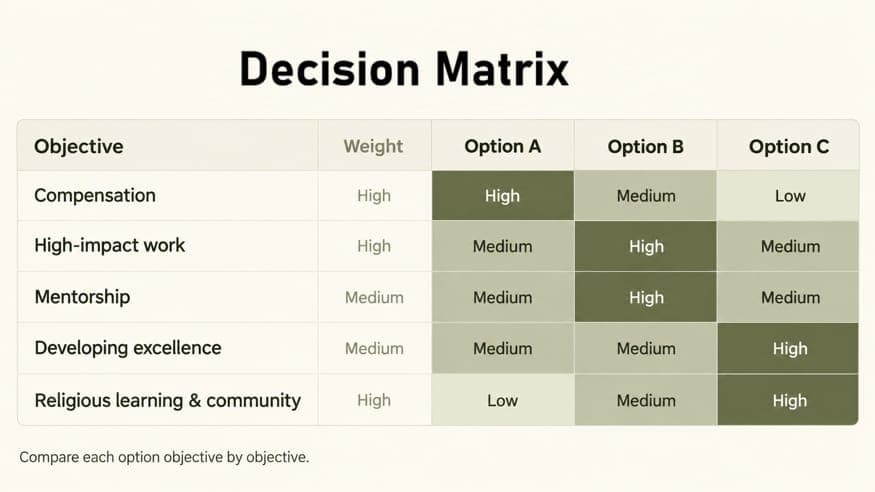
The same scorecard can then be used to judge each option against those objectives. Comparing options objective by objective reduces the risk that a general liking for one company, or one especially attractive feature of an offer, colours every judgment about it.
The scorecard also leaves a record of the reasoning behind the decision. That matters for accountability: the decision can later be assessed against the objectives and priorities that were actually stated, rather than against whatever outcome happened to follow.
What We Actually Control
None of this gives control over the eventual outcome. A role may change, a manager may leave, or an offer may turn out differently from what was expected.
What greater deliberation provides is agency over the parts of the decision that can be chosen deliberately: the objectives, the priorities assigned to them, and the reasoning used to compare the available options. Those are within the decision-maker's control; the final outcome is not. The claim, then, is not that a better process guarantees a better result, but that it makes the decision itself more deliberate and defensible.
This brings the distinction between proactive and reactive decision-making back into view. A proactive decision is not one that guarantees the right outcome (a guarantee of desired outcome never exists, all we can do is increase the likelihood of achieving our desired outcome), but one in which the person has consciously chosen what matters and used those objectives to guide the choice. A reactive decision allows the pressures of the moment to do that work instead.
That is what makes a career decision something one can answer for: not whether the job eventually turned out well, but whether the choice itself was made deliberately and in accordance with what one claimed to value.
Did I choose according to what I said mattered, or according to what felt most compelling in the moment?