

When was the last time you struggled to give each of your roles its due?
For a lot of us, the workday has started to lose its clear beginning and end. Meetings, messages, deadlines and urgent requests increasingly bleed into evenings and weekends, leaving less protected time for focused work, family presence and personal recovery, a pattern Microsoft's researchers have called the infinite workday. It is tempting to read this as a scheduling problem: too many meetings, not enough hours. But the calendar may not be where the real difficulty sits.
Why It Feels Impossible to Hold Together
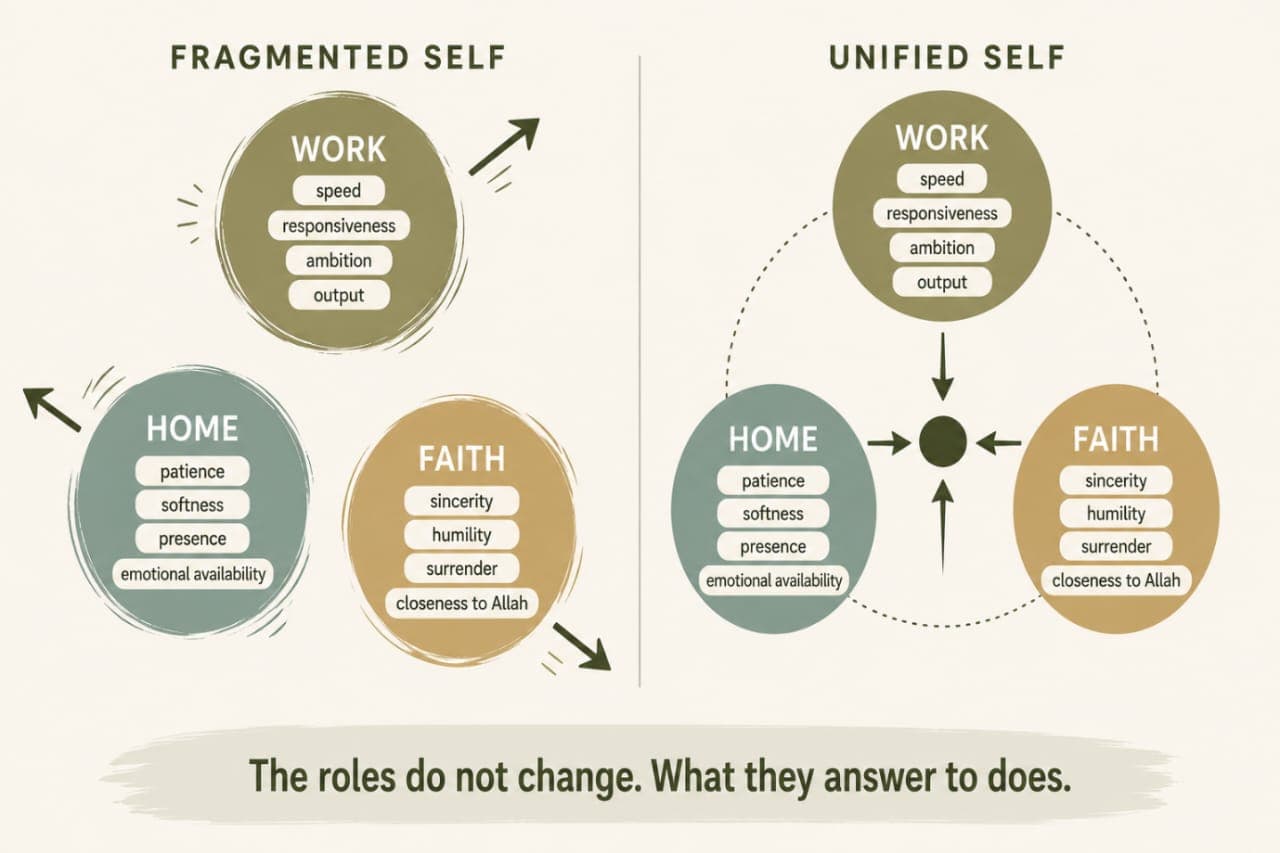
At a recent Ihsan Connect session, Dr. Ussama Ahmad Khan, who teaches Organisational Behaviour at London Business School, laid out why these obligations feel so impossible to hold together. Research usually frames work and family conflict in three ways: time-based, where work and family compete for the same hours, strain-based, where stress from one domain spills into the other, and behaviour-based, where the manner that works in one role does not translate to the other. But there is a deeper layer underneath those, an identity-based conflict, where you become one self at work, another at home, and another in religious spaces.
Each of those selves is rewarded for something different. Work rewards speed, responsiveness, ambition, output. Home asks for patience, softness, presence. Religion asks for sincerity, humility, closeness to Allah. When those selves are not unified, you do not feel busy. You feel pulled apart.
And here is why it hurts the way it does: identity conflict exposes what we are afraid to lose. Saying no at work can feel like losing the image of being competent. Saying no at home can feel like losing the image of being a good spouse, parent, or child. So we say yes to everyone, not out of principle, but out of fear of disappointing them. Dr. Khan called these attachments the hidden idols of the heart. Not statues, but anything whose loss would cause an internal collapse. Even good acts, serving family, excelling at work, being seen as reliable, become distorted when they quietly become the source of your worth.
One Purpose: Tawhid
Is there a single purpose that connects these roles? Dr. Khan's answer was tawhid. It usually names the belief that Allah is One, but it also means the purpose behind every role becomes one. Work, family, health, and ambition stop being competing identities and become responsibilities understood in relation to Allah. This changes how you evaluate conflict: the question is no longer how something affects your image, but what Allah requires in that moment. Sometimes that means giving more time to family. Sometimes it means fulfilling a professional responsibility properly. Sometimes it means protecting your own body and soul, because someone exhausted, resentful or spiritually empty cannot keep serving others. Tawhid does not remove the difficulty of competing responsibilities, but it gives you a centre through which the trade-offs can be understood. It also reframes the roles themselves as ways of knowing Allah: serving family can manifest His mercy and compassion, and excellence at work can become a way of recognising His gifts and serving creation responsibly. Balance, then, is not giving every role equal time, but giving every role its due under the authority of Allah.
Two Practices for Living It
Speaking alongside him, Shahrukh Tauqir made it concrete with two practices.
First: ask what is due from you, not what is due to you. He builds this on the Qur'anic idea of spending in the cause of Allah, but widens what counts as wealth beyond money to include your time, energy, and attention. A role mindset asks whether something is your job. A service mindset asks what right is being placed before you. The same limited capacity is being spent either way; the difference is whether you spend it grudgingly or as an act of service.
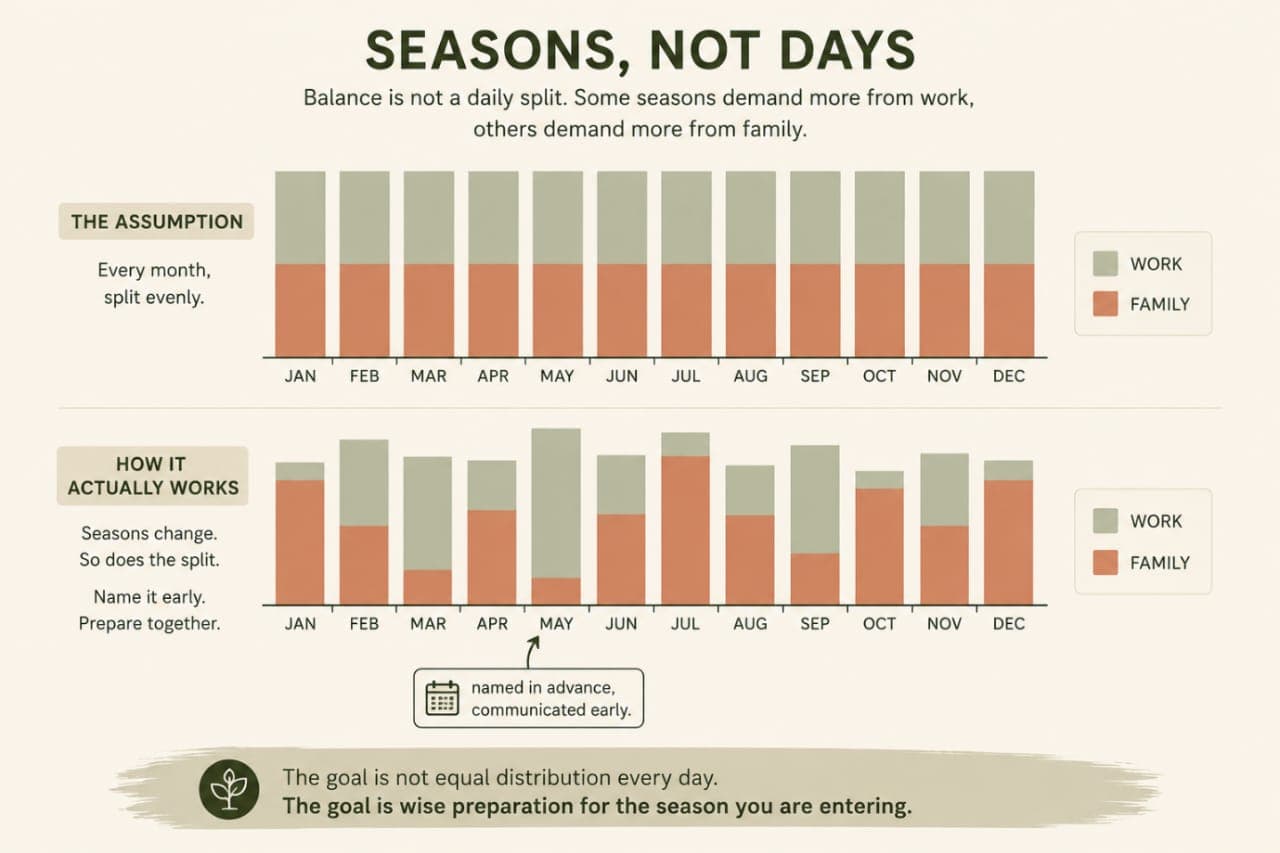
Second: live by seasons, not by days. Some seasons demand more from work, others more from family. Do not force an even split every 24 hours. Identify the season you are entering and prepare for it. And prepare by over-communicating, not under-communicating. Most last-minute friction is not because people will not help; it is because they were not given enough notice to adjust. A large meta-analysis on work and family conflict found the same: informal support at home and at work measurably reduces the strain, and support is far easier to give with warning.
The Cost of Stepping Back
The hardest part of the session was not about time at all. It was about what other people will say. When you step back from something visibly prestigious, you do not just lose the thing, you lose the standing that came with it. That cost is real. Tauqir spoke about a period when he stepped away from a demanding role and struggled to work out the equation before he left. His honest reflection was that there is no formula. The decision is the hard part. What followed was ordinary: habits, routines, focusing on what he could control.
The equation never fully resolves, and it is not meant to. What changes is the purpose you are solving it from. When your roles all connect to one purpose rather than competing for your worth, the trade-offs do not disappear, but they stop tearing you apart. You give each role its due, and you stop needing anyone's approval for why.